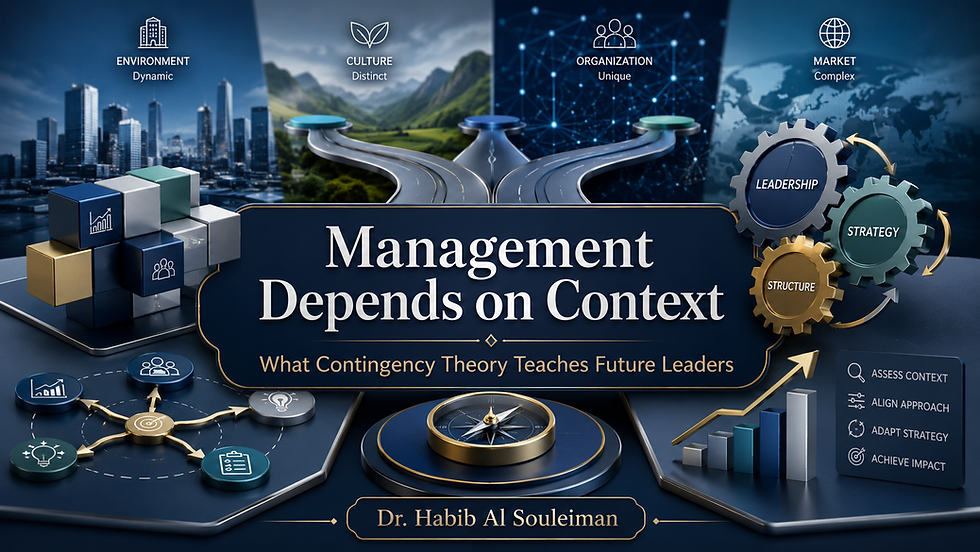
Management Depends on Context: What Contingency Theory Teaches Future Leaders
#Contingency_Theory gives students an important and practical lesson: management is not a fixed formula. A method that works well in one organization, country, team, or historical moment may not work in another. This does not mean that management theory is weak. It means that management is deeply connected to #context, people, goals, resources, and the wider #environment.
In simple terms, #Contingency_Theory teaches that there is no single best way to manage every situation. Good managers do not simply copy methods from books, famous companies, or successful leaders. Instead, they study the situation carefully and choose the most suitable approach. This makes the theory especially useful for students because it connects #management_education with real life.
A manager may need to be highly structured when a team is new, inexperienced, or facing risk. The same manager may need to be flexible and participative when working with creative professionals or experienced experts. In another setting, a manager may need to make quick decisions because the environment is uncertain or time is limited. The central lesson is clear: effective #leadership requires judgment, adaptation, and responsibility.
This article explains #Contingency_Theory from an educational perspective. It focuses on how students can use it to understand modern management, improve decision-making, and prepare for a better future. The article does not present the theory as a perfect answer to every problem. Rather, it treats it as a useful way of thinking about #organizations, #leadership, and #strategic_decision_making in a balanced and practical manner.
Theoretical Background
#Contingency_Theory developed as a response to earlier management ideas that often searched for universal principles. Classical management theories were valuable because they introduced structure, planning, hierarchy, and efficiency. However, they sometimes assumed that the same management method could be applied everywhere. Over time, scholars and practitioners observed that organizations are too complex for one fixed model.
The word “contingency” means that something depends on something else. In management, this means that the best decision depends on the situation. A leadership style, organizational structure, communication system, or control mechanism should fit the specific conditions in which an organization operates.
Several important factors shape this fit. One factor is the nature of the task. Routine work may require clear rules and standardized procedures, while innovative work may require flexibility and open communication. Another factor is the external #business_environment. A stable environment may allow long-term planning, while a fast-changing environment may require rapid learning and adjustment. A third factor is the people involved. Their skills, motivation, culture, expectations, and professional maturity influence which management style is most suitable.
#Organizational_Structure is also central to the theory. Some organizations work better with centralized decision-making, especially when safety, compliance, or consistency is important. Others need decentralized decision-making because they operate in complex markets or depend on creativity and local knowledge. The key question is not whether centralization or decentralization is always better. The key question is: which structure fits the situation?
This theoretical background helps students understand that management is not only about authority. It is also about diagnosis. A manager must read the situation before acting. This makes #critical_thinking an essential part of management education. Students should learn not only what management tools exist, but also when, why, and how to use them.
Analysis
The main strength of #Contingency_Theory is its realism. It accepts that organizations operate in different conditions. A small start-up is not the same as a large university, a hospital, a manufacturing company, a government agency, or a digital platform. Each has different goals, pressures, cultures, and risks. Therefore, each may require different management practices.
For students, this is a valuable lesson because it prevents simple thinking. It is easy to say that all organizations need strong leadership, teamwork, innovation, or efficiency. These ideas are generally positive, but they are not enough. The deeper question is how these ideas should be applied in a particular context.
For example, #teamwork is important, but teamwork in an emergency medical unit is different from teamwork in a research department. In an emergency setting, clear roles and quick decisions may be essential. In a research setting, discussion, exploration, and intellectual freedom may be more suitable. Both are forms of good management, but they are good in different ways because they respond to different needs.
The same applies to #leadership_style. A participative leader may be highly effective when employees are skilled and motivated. However, if a team is confused, inexperienced, or under serious time pressure, employees may need clearer direction. This does not mean that one style is morally better than the other. It means that responsible leadership requires understanding what the situation demands.
#Contingency_Theory also helps explain why imported management models sometimes fail. A company may copy a successful method from another country or industry, but the method may not fit its own culture, resources, or institutional environment. This is an important educational point. Students should admire successful models, but they should also learn to adapt them carefully. #Best_practice is useful only when it is translated into the local reality.
Another important area is #change_management. When organizations face technological change, economic uncertainty, or new social expectations, managers must adjust. A rigid organization may struggle because it continues to use old methods in new conditions. However, a flexible organization can learn, redesign processes, and respond more intelligently. Contingency thinking therefore supports #organizational_learning.
At the same time, the theory should not be misunderstood as saying that “anything can work.” Context matters, but principles still matter. Ethical behavior, respect for people, legal compliance, transparency, and responsibility remain important in all settings. #Contingency_Theory does not remove values from management. It asks managers to apply values wisely in different situations.
Discussion
The educational value of #Contingency_Theory is especially strong because it teaches students to avoid automatic answers. In business education, students often want clear formulas. They may ask: What is the best leadership style? What is the best structure? What is the best strategy? Contingency thinking answers: it depends, and your task is to understand what it depends on.
This answer may seem simple, but it is intellectually demanding. It requires students to analyze evidence, compare options, consider risks, understand people, and think about consequences. In this sense, #Contingency_Theory supports mature #managerial_judgment.
For future leaders, this way of thinking is highly relevant. The modern world is shaped by digital transformation, artificial intelligence, sustainability challenges, international competition, changing student and employee expectations, and complex social environments. In such a world, fixed management models are often not enough. Leaders need adaptive intelligence.
For example, #digital_transformation cannot be managed in the same way in every organization. A technology company may adopt new tools quickly because its employees already have strong digital skills. A traditional institution may need more training, cultural preparation, and careful implementation. A manager who ignores these differences may create resistance or confusion. A manager who understands #context can design a better transition.
The same applies to #sustainability. Some organizations can immediately invest in advanced green technologies. Others may need gradual improvement, partnerships, or education before major transformation becomes possible. A contingency approach allows managers to support positive change without ignoring practical limitations.
In education, #Contingency_Theory can also help teachers and academic leaders. Students are not all the same. Some learn better through discussion, others through practice, reading, research, or case studies. A good educational manager understands that teaching methods should fit the learners, the subject, the level of study, and the learning outcomes. This makes the theory useful not only for business, but also for #higher_education.
However, the theory also has limits. Because it emphasizes context, it can sometimes become too broad. If every answer is “it depends,” students may feel that the theory does not provide enough guidance. This is why it should be taught with frameworks, examples, and case analysis. Students need to learn how to identify relevant factors, not simply repeat that every situation is different.
Another limitation is that managers may use “context” as an excuse for weak decisions. For example, a leader might say that strict control is necessary because of the situation, even when better communication would be possible. Therefore, contingency thinking must be combined with #ethical_leadership and reflective practice. The aim is not to justify any decision, but to choose decisions that fit the situation while remaining fair, responsible, and constructive.
This balance is important for a better future. Good management is not only about achieving results. It is also about building organizations that are resilient, humane, and capable of learning. #Contingency_Theory contributes to this goal by encouraging leaders to think carefully before acting.
Conclusion
#Contingency_Theory remains one of the most useful ideas in management education because it teaches a realistic and balanced lesson: there is no one-size-fits-all approach to management. Effective managers adapt their style to the people, the problem, the organization, and the wider environment.
For students, the theory is valuable because it develops #critical_thinking, practical judgment, and respect for complexity. It helps them understand why the same method may succeed in one place and fail in another. It also teaches that good leadership is not about copying fashionable models, but about understanding reality and responding wisely.
The positive lesson is clear. Future managers should be flexible, analytical, ethical, and open to learning. They should understand that #leadership is not only a position, but also a responsibility to choose the right approach for the right situation. When used with care, #Contingency_Theory can help build better organizations, better educational systems, and better futures.