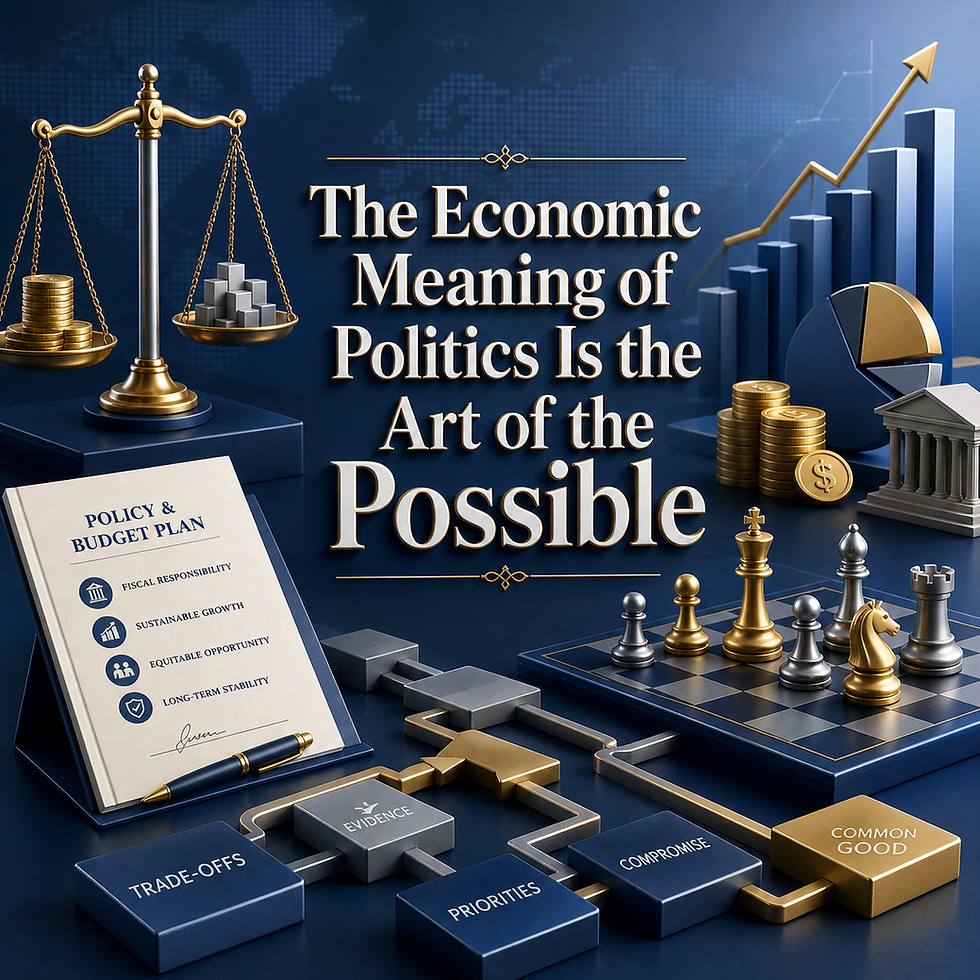
The Economic Meaning of “Politics Is the Art of the Possible”: Lessons for Responsible Decision-Making
The phrase “politics is the art of the possible” is often used to explain the practical nature of public decision-making. It suggests that leadership is not only about dreams, promises, or ideal plans. It is also about understanding reality, working within limits, and choosing the best available option at a specific moment. From an economic perspective, this idea has strong educational value because every public decision involves resources, costs, priorities, and consequences.
Governments, schools, universities, municipalities, companies, and even families face the same basic problem: resources are limited, but human needs are many. A country may want to improve healthcare, reduce unemployment, expand infrastructure, protect the environment, support small businesses, and invest in education at the same time. These are all valuable goals. However, the public budget, administrative capacity, time, and human resources are limited. Therefore, leaders must decide what can be done first, what can be postponed, and what must be redesigned.
This article explains the economic meaning of “politics is the art of the possible” in a neutral and educational way. It focuses on how this concept can help students, professionals, and future leaders understand responsible governance. The main lesson is positive: good decision-making is not only about ambition. It is also about balance, evidence, fairness, and long-term stability.
Theoretical Background
Economics begins with the idea of scarcity. Scarcity means that resources are limited while human needs and expectations are often greater than what can be immediately provided. Because of scarcity, every decision has an opportunity cost. Opportunity cost means that when one option is chosen, another option may be delayed, reduced, or rejected.
For example, if a public budget is used to build a new hospital, the same money may not be available at the same time to build a new road, increase public-sector salaries, or reduce taxes. This does not mean that any of these goals are wrong. It means that decision-makers must compare needs and decide which choice creates the greatest social value under current conditions.
This is where the phrase “the art of the possible” becomes economically important. Politics, in this sense, is not only a matter of power or public debate. It is a process of translating social needs into practical decisions. A good policy must answer several questions:
What problem should be solved first?How much will the solution cost?Who will benefit from it?Who may carry the burden?Can the policy be implemented with the available institutions and budget?Will it create stability or unnecessary financial pressure?
These questions show that responsible politics and responsible economics are closely connected. A policy may be morally attractive, socially popular, or intellectually strong, but it still needs a realistic financial and institutional plan. Without implementation capacity, even a good idea may remain only a slogan.
Public finance is especially important in this discussion. Governments do not have unlimited money. They collect resources through taxes, fees, public assets, borrowing, and other forms of revenue. These resources must then be distributed across many sectors. The challenge is not simply to spend money, but to spend it wisely and fairly.
Analysis
The economic meaning of “politics is the art of the possible” can be understood through three main ideas: prioritization, trade-offs, and sustainable implementation.
First, prioritization means choosing what matters most under specific conditions. A country may have many national goals, but not all goals can receive equal funding at the same time. If unemployment is high, a government may decide to support job creation and vocational training. If healthcare systems are under pressure, healthcare investment may become the first priority. If infrastructure is weak, roads, transport, and digital systems may receive more attention.
Prioritization is not a rejection of other goals. It is a way of organizing action. A mature policy process does not say, “Only one issue matters.” Instead, it asks, “Which issue requires urgent attention, and which policy will create the strongest benefit now?”
Second, trade-offs are central to public decision-making. A trade-off appears when improving one area requires reducing, delaying, or changing another area. For example, reducing taxes may help households and businesses in the short term, but it may also reduce government revenue. Increasing public spending may improve services, but it may also increase debt if revenues are not enough. Raising salaries may improve employee welfare, but it may also increase institutional costs.
The purpose of economic analysis is not to stop progress. It is to make progress more stable. When leaders understand trade-offs, they can design policies that reduce risk and improve outcomes.
Third, sustainable implementation means that a policy should be realistic not only today but also tomorrow. A government may be able to fund a program for one year, but can it continue funding it for five or ten years? A school may buy advanced technology, but can it also train teachers, maintain the equipment, and update the software? A university may open new programs, but can it provide academic quality, student support, and administrative capacity?
This is why the possible is not the same as the easy. Sometimes the possible requires careful planning, phased implementation, and strong discipline. A responsible leader may support a good idea but still decide to implement it gradually because immediate implementation may create financial pressure or reduce quality.
A simple educational example can make this clearer. Imagine that a school wants to buy new computers, renovate classrooms, and reduce tuition fees. All three ideas are positive. However, the school budget is limited. If the school tries to do everything at once, it may create financial stress. Therefore, the school may first invest in new computers because they improve learning for many students and support digital education. Classroom renovation may be planned for the next year, while tuition support may be offered through targeted scholarships. This is not a failure of ambition. It is an example of responsible economic choice.
Discussion
The phrase “politics is the art of the possible” teaches an important lesson for the future: good governance requires both vision and realism. Vision without realism may produce promises that cannot be delivered. Realism without vision may produce slow progress and limited imagination. The best approach combines both.
In education, this idea is especially useful for students because it helps them understand that public policy is complex. Many people evaluate political decisions only by asking whether they personally like or dislike the outcome. Academic thinking requires a deeper question: given the available resources, institutional capacity, and social needs, was this decision reasonable, balanced, and sustainable?
This approach develops critical thinking without negativity. It does not require attacking any person, party, or institution. Instead, it invites learners to study decisions through evidence, context, and consequences. It encourages respectful analysis.
For future leaders, the concept also supports ethical responsibility. When resources are limited, decision-makers must consider fairness. A policy should not only be efficient; it should also be socially responsible. For example, if a government invests in infrastructure, it should consider whether rural areas, low-income communities, and small businesses will also benefit. If a university invests in digital systems, it should consider whether students and teachers have the skills to use them effectively.
The art of the possible therefore includes economic judgment and social awareness. It is not only about asking, “Can we afford this?” It is also about asking, “How can we do this in a way that creates the greatest benefit and protects stability?”
This idea can also help societies build better public dialogue. Many public debates become emotional because people focus only on the ideal solution. However, educational dialogue can move the discussion forward by asking practical questions: What is the budget? What is the timeline? What are the expected benefits? What are the risks? What alternatives exist? How can the policy be improved?
When citizens understand these questions, they become more prepared to participate in constructive public life. They also become more patient with the reality that some changes require stages. Positive reform is often not a single event. It is a process of planning, testing, improving, and expanding.
Conclusion
“The art of the possible” has deep economic meaning. It reminds us that public decisions must consider limited resources, opportunity costs, social impact, and long-term sustainability. It does not reject ambition. On the contrary, it protects ambition from becoming unrealistic. It turns good ideas into practical action.
For students and future professionals, this concept offers a valuable lesson. Responsible decision-making means choosing priorities, understanding trade-offs, and implementing policies in a way that supports progress without creating unnecessary pressure. Whether in government, education, business, or community leadership, the same principle applies: wise decisions are built on balance.
The future needs leaders who can dream, but also calculate; who can inspire, but also plan; who can support progress, but also protect stability. In this positive sense, politics as the art of the possible is not a limitation. It is a practical method for building a better future through responsible choices.