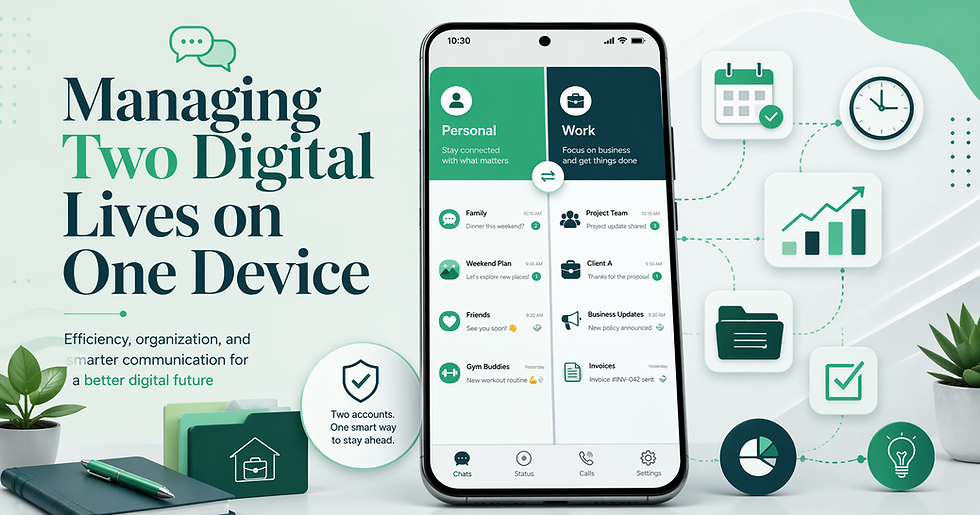
Managing Two Digital Lives on One Device: What WhatsApp’s Two-Account Feature Teaches Us About Efficiency, Micro-Entrepreneurship, and Everyday Economic Organization
Digital communication tools are no longer used only for social interaction. They now shape work routines, small business practices, client relationships, and everyday forms of economic organization. For freelancers, independent consultants, informal sellers, service providers, and small business owners, mobile messaging has become part of the infrastructure of economic life. In many contexts, a smartphone is not simply a personal device. It is also a work tool, a customer service channel, a scheduling system, a sales interface, and sometimes even a basic business office.
Within that context, the ability to operate two WhatsApp accounts on one phone is more than a technical convenience. WhatsApp officially introduced multiple accounts on Android in 2023, allowing two accounts to be logged in on the same device, and expanded the same capability to iPhone users in March 2026. WhatsApp’s own guidance explains that the feature requires a separate phone number for the second account, and that users can switch between accounts while managing them separately. The company also frames the feature around separating work and personal communication without needing two phones or repeated logins.
From an economic perspective, this matters because communication friction has costs. When users must constantly log in and out, carry multiple devices, or rely on awkward workarounds, time is lost, attention is fragmented, and errors become more likely. A design change that reduces such friction can support better time use, clearer role separation, and more orderly communication habits. For small-scale economic actors, even minor gains in organization can accumulate into meaningful improvements in productivity and perceived professionalism.
This article examines WhatsApp’s two-account feature not as a product review, but as a case study in digital efficiency and applied economic behavior. The central argument is that seemingly small interface changes can produce broader educational value. They help us understand how digital tools influence labor organization, transaction costs, communication discipline, and the management of boundaries between personal and professional life. The article also explores what students, educators, and future professionals can learn from this development when thinking about a more organized and human-centered digital future.
Theoretical Background
A useful starting point is transaction cost thinking. In economic life, many costs are not direct financial payments. Some costs arise from the effort required to search, coordinate, clarify, follow up, and correct mistakes. Communication systems can either increase or reduce those costs. If a person must maintain separate phones, regularly switch devices, or risk sending messages from the wrong identity, the cost is not only technical inconvenience. It is a coordination burden. Over time, this burden affects efficiency.
Digital platforms often become more valuable when they reduce friction in routine tasks. Friction, in this sense, includes extra steps, unnecessary repetition, identity confusion, interface complexity, and context switching. For freelancers and small business owners, context switching is especially important. Many do not have formal departments, assistants, or enterprise software. Their business operations are often compressed into one device and one daily routine. A feature that helps separate client communication from family or personal communication can support cognitive order as much as technical order.
A second useful framework comes from attention economics. Human attention is finite. In contemporary digital life, messaging platforms compete for it constantly. When personal and professional messages are mixed in one stream, the user must invest more mental energy in sorting priorities, preserving tone, and avoiding errors. Two separate accounts can function as a modest but meaningful form of attention management. Separate spaces may help users respond more deliberately, maintain better records of communication, and reduce the mental fatigue associated with blurred boundaries.
Third, role theory helps explain why communication separation matters socially as well as economically. Individuals occupy multiple roles at the same time: friend, parent, teacher, consultant, seller, student, manager, or advisor. Each role carries different expectations. A person speaking to a client is not communicating under the same social logic as when speaking to a sibling or close friend. The separation of communication channels can therefore support role clarity. Role clarity is important because it reduces ambiguity, and ambiguity often creates inefficiency.
Fourth, boundary management theory is relevant. The modern mobile worker often experiences the collapse of boundaries between work and private life. A single phone already brings many domains together. This can be helpful, but it can also create pressure. When one messaging account is used for every purpose, the device becomes a place of constant overlap. A second account does not solve every problem, but it can provide a structured boundary inside one device. The significance of this is not only technical. It is behavioral and organizational.
Finally, from the perspective of digital inclusion, this feature is important because not every user can afford multiple devices. In many parts of the world, small-scale entrepreneurship grows through low-cost digital tools rather than expensive formal systems. A feature that allows two accounts on one phone supports practical inclusion. It enables better organization without requiring the user to buy and maintain another handset. In a time when mobile communication plays a central role in commerce, access to such organizational tools can matter for economic participation.
These theories suggest that WhatsApp’s two-account feature can be interpreted as a small technological change with wider lessons. It shows that digital design decisions can shape labor habits, client interaction, and the ability of individuals to manage increasing complexity in everyday economic life.
Analysis
WhatsApp’s official position makes the feature’s practical intention clear. The company describes two accounts on one phone as a way to keep work and personal use separate without carrying two phones or logging out each time. Its help materials also note that a second account requires a separate phone number and can be switched from within the app. In 2026, WhatsApp announced that this dual-account capability had reached iOS as well, meaning the feature now spans both major mobile ecosystems.
Economically, the first major benefit is time efficiency. Consider a freelancer who handles family messages, project updates, client calls, appointment confirmations, and payment reminders on the same device. Before a built-in two-account function, the user might have depended on two phones, manual logging out, or partial substitutes such as using one account in a less integrated way. Each workaround requires time and introduces disruption. A dual-account structure reduces the number of operational steps. It simplifies access and lowers routine communication overhead.
The second benefit is error reduction. Communication errors may appear small, but they can have reputational costs. Sending a personal message in a professional context, missing an urgent customer inquiry because it is buried under non-work chats, or replying from the wrong account can weaken confidence. By separating account environments, the user gains a clearer structure for message handling. Even a slight reduction in confusion can matter in client-facing work, especially for solo operators whose reputation depends heavily on responsiveness and tone.
The third benefit is improved communication governance. A single user on a single phone may still need different privacy settings, profile identities, notification patterns, and conversational norms depending on context. WhatsApp’s help materials indicate that each registered account can be managed as its own account environment. This matters because governance in digital communication is not only about security in the narrow sense. It also concerns order, control, and intentionality in how communication is conducted.
A fourth benefit concerns micro-enterprise legitimacy. Many small businesses begin informally. They often operate through messaging before building websites, customer portals, or full software systems. In such settings, the ability to maintain a distinct communication identity can strengthen trust. A dedicated account for customers can signal consistency and seriousness. This does not automatically create professionalism, but it can support it. Professionalism is often built through repeated small signals: timely replies, clear profile identity, orderly message flow, and fewer communication mistakes.
A fifth benefit is affordability. For users with limited resources, the opportunity to manage two communication spheres on one device can reduce hardware needs. This does not eliminate all costs, since the user still needs a second number, but it lowers the barrier compared with carrying and maintaining two separate phones. In educational terms, this is important because it shows how software design can substitute for material duplication. Better design sometimes reduces the need for more equipment.
There is also a broader lesson here about platform evolution. WhatsApp’s 2023 announcement introduced the feature on Android, and the 2026 update extended it to iOS. This timeline suggests that platform improvements often develop gradually, first solving a problem in one ecosystem and later standardizing it more broadly. That pattern is useful for students studying digital markets. Innovation is not always dramatic. Sometimes it consists of extending a practical capability to a wider user base at the right moment.
Another analytical point concerns the relationship between communication and productivity. Productivity is often discussed in terms of software automation, artificial intelligence, or major infrastructure. Yet everyday productivity also depends on ordinary design details. A person who spends less time switching devices and less energy managing confusion has more cognitive space for higher-value work. This is especially relevant in service sectors where the person is both the worker and the communication manager.
For educators, the feature offers a concrete teaching example. It can be used to explain concepts such as transaction costs, digital labor, boundary management, and user-centered design. Students often understand theory better when it is connected to familiar tools. A messaging feature may look simple, but it opens a window into how digital systems influence work organization. This makes it suitable for business, management, economics, media studies, and digital society discussions.
Importantly, a balanced analysis should not exaggerate the feature. Two accounts on one phone do not remove all communication pressure. They do not automatically create work-life balance, better customer relations, or stronger business strategy. Outcomes still depend on user habits. If both accounts remain equally disorganized, the technical feature alone will not solve deeper problems. But this limitation does not reduce its value. It simply reminds us that tools work best when paired with disciplined practices.
Discussion
The deeper educational value of this case lies in what it teaches about the future of digital organization. First, it shows that innovation can be meaningful even when it is modest. A better future is not built only through large-scale technological transformation. It is also built through smaller design decisions that reduce confusion, support clarity, and help ordinary users manage complexity more effectively.
Second, the case illustrates the growing importance of human-centered digital infrastructure. When platforms recognize that users live in multiple roles at once, they move closer to real social conditions. Many people are no longer only consumers of communication tools. They are hybrid actors: workers, learners, family members, and service providers operating through the same device. Design that acknowledges this reality is socially relevant.
Third, the feature highlights the educational importance of boundary literacy. Digital literacy should not be reduced to technical ability alone. It should also include the ability to organize one’s communication spaces, set role boundaries, and use technology in ways that protect attention and preserve clarity. In this sense, the feature is not only a convenience. It is an opportunity to teach healthier digital habits.
Fourth, there is a lesson for entrepreneurship education. Many entrepreneurship programs focus on finance, marketing, and strategy, which are important. Yet the success of small ventures often depends on operational discipline in daily communication. Missed replies, mixed identities, and cluttered messaging environments can undermine otherwise good business ideas. Educators can therefore use this example to show students that professionalism begins with practical systems, even very simple ones.
Fifth, this case speaks to inclusive development. A more organized digital future should not be available only to those with high-end infrastructure. Features that help people manage work and personal life on a single device support broader participation. They may be especially useful in regions where mobile-first business activity is common and where device multiplication is not always practical. From a development perspective, small usability improvements can have wider effects when they are adopted at scale.
There is also a normative lesson. The ideal digital future is not one in which people are permanently available for work. Rather, it is one in which communication becomes more manageable, intentional, and respectful of human limits. A two-account feature can support this if users employ it to structure their day, separate obligations, and protect space for non-work life. In that sense, the feature can contribute to healthier digital practice, provided it is used thoughtfully.
From a research perspective, the topic invites further study. Scholars could investigate whether dual-account use improves response quality, reduces communication errors, or changes perceived professionalism among freelancers and small businesses. Researchers could also explore how such features influence work-life boundaries in different cultural and economic settings. The subject is especially suitable for applied studies because it connects platform design with everyday behavior.
For public discussion, the case is also helpful because it keeps the focus on constructive learning. It avoids unnecessary polarization and instead asks a more productive question: what can society learn from small technological changes that make daily life more organized? The answer is that better systems are often built incrementally. When a feature reduces friction and helps people communicate with more order, it may support not only convenience but also dignity, efficiency, and better habits.
Conclusion
WhatsApp’s two-account feature offers a useful case for understanding the economics of everyday digital communication. Officially introduced for Android in 2023 and later extended to iOS in 2026, the feature enables users to maintain two separate WhatsApp accounts on one phone, each tied to a different number. In practical terms, this reduces the need to log in and out or carry multiple devices, while supporting clearer separation between personal and professional communication.
Its significance, however, goes beyond convenience. The feature demonstrates how small improvements in digital design can reduce communication friction, support better time use, lower the risk of messaging errors, and strengthen operational order for freelancers and small business owners. It also offers an accessible teaching example for students interested in economics, management, digital labor, and entrepreneurship.
The wider lesson is optimistic and practical. A better future is not built only through grand inventions. It is also shaped by thoughtful tools that help people manage real life more effectively. When communication becomes more organized, people gain more than speed. They gain clarity, structure, and sometimes a stronger sense of control over their work and daily responsibilities.
For educational purposes, this is the most valuable takeaway. Technology should not only be measured by novelty. It should also be evaluated by how well it helps ordinary users live, learn, and work with greater order and less unnecessary friction. In that respect, WhatsApp’s two-account feature is a small but meaningful example of design serving practical human needs.